

Supply vs Demand Gap in Tricity Real Estate Explained
Understand the supply-demand gap in Tricity real estate, its causes, trends, and what it means for buyers and investors.
 PropertyPocketsUpdated 5 months Ago4 Mins read
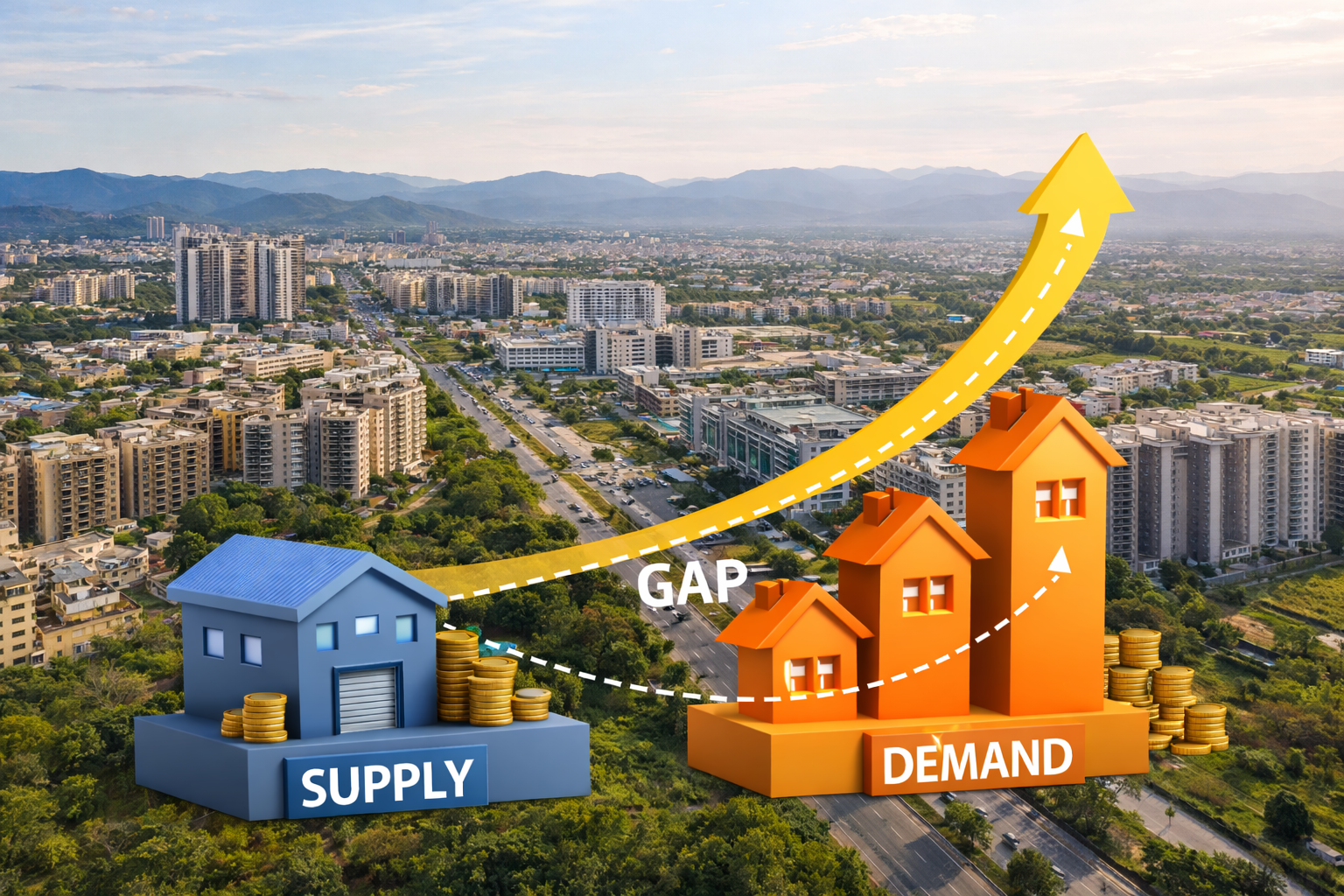
The Tricity region—comprising Chandigarh, Mohali, and Panchkula—has emerged as one of North India’s most dynamic real estate markets. Known for its planned infrastructure, high livability index, and growing economic opportunities, the region has witnessed consistent real estate activity over the past decade.
However, beneath the surface of growth lies a critical imbalance: the supply vs demand gap. This gap is not just a statistic—it is a powerful force shaping pricing, inventory movement, buyer behavior, and long-term investment potential.
This article dives deep into what this gap means, why it exists, how it varies across segments, and what it signals for the future of Tricity real estate.
Understanding the Concept: Supply vs Demand
At its core, the supply-demand gap refers to the difference between:
- Supply: The number of available properties (ready-to-move + under-construction)
- Demand: The number of buyers actively seeking properties
When demand exceeds supply, prices rise, inventory gets absorbed quickly, and sellers gain power. Conversely, when supply exceeds demand, prices stagnate, discounts increase, and buyers gain leverage.
In Tricity, the situation is not uniform—it is segmented, location-specific, and evolving rapidly.
The Current Reality: A Market of Contrasts
The Tricity market today is not facing a single type of imbalance. Instead, it is experiencing multiple micro-level gaps across different categories:
1. High Demand, Low Supply (Premium & Mid-Segment)
Areas like:
- Aerocity
- IT City
- Sector 82–85 Mohali
- New Chandigarh
are witnessing strong demand but limited ready inventory.
Why?
- Increasing migration of professionals
- Rising NRI investments
- Preference for gated, premium living
Impact:
- Price appreciation of 15–25% in recent years
- Faster sales cycles
- Low negotiation margins
2. High Supply, Moderate Demand (Peripheral Areas)
Locations like:
- Kharar-Landran Road
- Zirakpur outskirts
have seen aggressive development, leading to oversupply in certain segments.
Why?
- Easy land availability
- Rapid builder activity
- Lower entry price attracting investors
Impact:
- Slower inventory absorption
- Price stagnation in some pockets
- Rental yield pressure
3. Mismatch Supply (What Buyers Want vs What Exists)
One of the biggest gaps is not just quantity—but relevance of supply.
For example:
- Buyers want 2BHK premium apartments under ₹1 Cr
- Market offers either:
- Basic 2BHKs (low quality), or
- Premium 3BHKs (higher budget)
This creates a functional supply gap, even when inventory exists.
Key Drivers Behind the Supply-Demand Gap
1. Urban Saturation of Chandigarh
Chandigarh is a planned city with limited expansion capacity. New supply is extremely restricted.
Result:
- Demand spills over into Mohali, Zirakpur, and Panchkula
- Prices in Chandigarh remain consistently high
- Peripheral areas become growth hotspots
2. Rise of Mohali as a Growth Engine
Mohali has transformed into the primary expansion zone of Tricity.
Key growth factors:
- IT hubs (IT City, Quark City)
- Airport connectivity
- GMADA planning
However, supply here is often:
- Concentrated in specific pockets
- Skewed towards certain configurations
This leads to localized demand-supply mismatches.
3. Investor vs End-User Dynamics
The Tricity market has a mix of:
- Investors: Looking for appreciation
- End-users: Looking for livability
When investor-driven supply increases:
- Projects launch faster
- Inventory builds up
But if end-user demand doesn’t match:
- Unsold stock rises
- Price growth slows temporarily
4. NRI Influence
NRIs play a significant role in Tricity real estate.
They typically demand:
- Premium construction
- Secure gated communities
- Brand-driven projects
However, supply often lags in:
- Quality consistency
- Delivery timelines
This creates a gap between expected and available inventory.
5. Regulatory & Approval Delays
Approvals, land clearances, and policy delays impact supply cycles.
Effect:
- Delayed project launches
- Reduced ready inventory
- Artificial shortage in high-demand areas
Segment-Wise Analysis of Supply vs Demand
Residential Real Estate
Affordable Segment (<₹50L)
- High supply
- Moderate demand
- Investor-heavy market
Challenge:
Quality and infrastructure concerns reduce end-user interest.
Mid-Segment (₹50L–₹1.2Cr)
- Strong demand
- Limited premium supply
This is the most critical gap zone.
Opportunity:
Builders who position correctly can dominate this segment.
Premium Segment (₹1.2Cr+)
- Growing demand (especially NRIs)
- Limited high-quality supply
Trend:
Shift towards lifestyle-driven housing.
Commercial Real Estate
SCOs, Showrooms, High-Street Retail
- High demand in prime locations
- Limited supply
Result:
- Rapid price escalation
- Strong rental yields
Office Spaces
- Moderate supply
- Increasing demand due to IT expansion
However:
- Demand is concentrated in specific zones (IT City, Aerocity)
Malls & Retail Floors
- Selective demand
- Oversupply risk in certain micro-markets
Area-Wise Supply Demand Dynamics
Aerocity & Airport Road
- High demand from NRIs and professionals
- Limited ready inventory
Status: Demand > Supply
IT City & Sector 82–85
- Emerging IT-driven demand
- Planned development
Status: Balanced but tightening supply
Kharar-Landran Road
- High supply of affordable housing
- Moderate end-user demand
Status: Supply > Demand
Zirakpur
Zirakpur has seen explosive growth.
- High supply
- Mixed demand
Status: Volatile market with micro-level variations
New Chandigarh
- Future growth potential
- Limited current demand
Status: Supply ahead of demand (long-term play)
Pricing Impact of Supply-Demand Gap
The supply-demand imbalance directly affects:
1. Price Appreciation
- High demand + low supply → rapid price increase
- High supply + low demand → stagnant prices
2. Negotiation Power
- Seller’s market (low supply): limited negotiation
- Buyer’s market (high supply): heavy discounts
3. Rental Yield
- High demand areas: better rental returns
- Oversupplied zones: lower yields
Behavioral Shift in Buyers
Today’s buyers are:
- More informed (digital research, portals)
- More selective (location + lifestyle)
- ROI-driven (especially investors)
This has created intelligent demand, which further widens the gap when supply doesn’t match expectations.
The Hidden Gap: Perception vs Reality
One of the most overlooked aspects is:
“Market mein inventory hai… par buyer ke liye relevant inventory nahi hai.”
This means:
- Builders think supply is sufficient
- Buyers feel options are limited
This perception gap creates:
- Slower sales cycles
- Confusion in pricing
- Marketing challenges
Future Outlook: Where Is the Market Heading?
1. Shift Toward Peripheral Growth
As Chandigarh saturates, growth will continue in:
- Mohali outskirts
- New Chandigarh
- Zirakpur extensions
2. Rise of Smart, Targeted Supply
Developers will need to focus on:
- Specific buyer personas
- Budget-fit configurations
- Lifestyle-driven offerings
3. Consolidation of Developers
Only serious, quality-focused builders will survive.
4. Increased Role of Data & Marketing
Real estate will shift from:
- “Build and sell”
to - “Understand demand and build”
Strategic Insights for Buyers & Investors
For Homebuyers
- Focus on location + future growth
- Avoid oversupplied areas unless pricing is attractive
- Prioritize ready or near-possession projects
For Investors
- Enter markets where demand is rising but supply is still limited
- Look for micro-market trends, not just city-level data
- Balance between appreciation and rental yield
For Builders & Developers
- Study demand deeply before launching
- Avoid generic supply
- Position projects based on psychographics, not just price
Conclusion
The supply vs demand gap in Tricity real estate is not a simple imbalance—it is a multi-layered, evolving phenomenon shaped by urban planning, migration, investor behavior, and market psychology.
Understanding this gap is crucial because:
- It explains why prices rise in some areas and stagnate in others
- It reveals hidden opportunities for smart investors
- It highlights the importance of strategic development
In a market like Tricity, success is no longer about just buying or selling property—it is about understanding the gap between what exists and what is truly needed.
And those who understand this gap… will always stay ahead of the market.
- chandigarh real estate trends
- commercial property tricity
- housing shortage tricity
- Mohali Property Market
- Property Investment Punjab
- property market chandigarh
- Property Price Trends
- real estate analysis india
- real estate demand india
- real estate growth punjab
- real estate insights
- residential demand mohali
- supply demand gap
- Tricity Real Estate
- Zirakpur Property







Commercial Property Boom in Mohali – SCOs, Booths & Offices
Explore why commercial property in Mohali is booming. Expert analysis of SCOs,...
PropertyPockets3 Mins read

Homeland–VRC ₹1,000 Cr Mohali Land Deal Signals Growth
Homeland Group and VRC acquire 18.5 acres in Mohali for ₹1,000 crore....
PropertyPockets4 Mins read
Mohali vs Zirakpur vs New Chandigarh – Where Are Prices Rising Fastest?
Mohali, Zirakpur or New Chandigarh—compare property price growth, investment potential, rental demand...
PropertyPockets3 Mins read
Top 5 Traffic Hotspots in Mohali (And Why They’re Failing)
Discover the top 5 traffic hotspots in Mohali and why poor planning,...
PropertyPockets4 Mins read





Leave a comment