

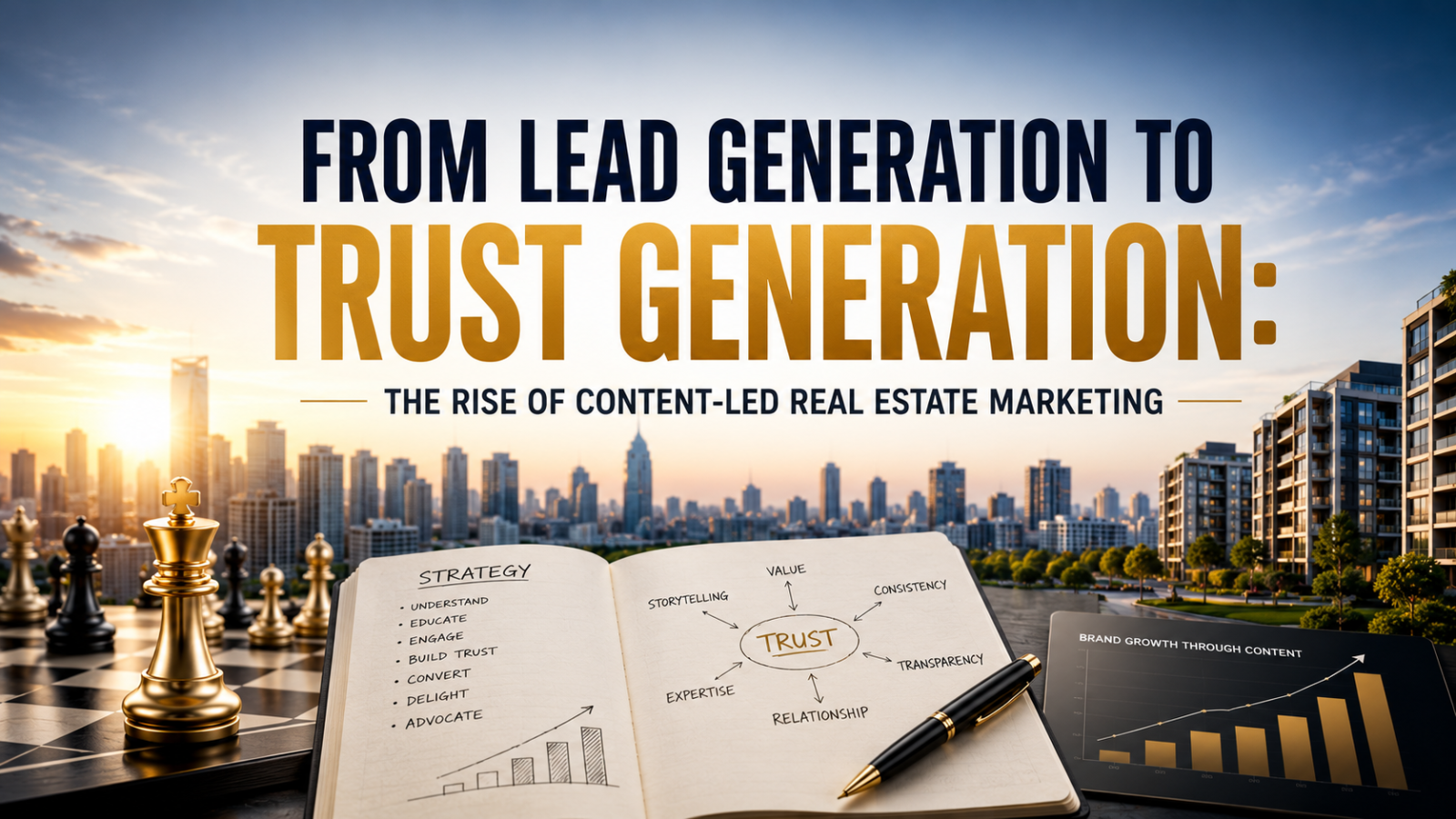
From Lead Generation to Trust Generation: The Rise of Content-Led Real Estate Marketing
How Content is Reshaping the Psychology, Branding, and Business of Modern Real Estate
 PropertyPocketsUpdated 4 months Ago6 Mins read
Real Estate Marketing is Facing an Identity Crisis
For years, the real estate industry believed marketing meant one thing:
“Generate more leads.”
The formula looked simple:
Run ads → collect leads → call buyers → schedule site visits → close deals.
This system dominated the industry for almost two decades. Builders measured success through inquiry numbers. Agencies sold CPLs. Sales teams chased databases. Portals focused on traffic volume.
But slowly, cracks started appearing.
- Marketing budgets increased.
- Lead quality dropped.
- Buyer trust weakened.
- Follow-up cycles became longer.
- Sales conversion ratios started shrinking.
The industry realized something uncomfortable:
Modern buyers are no longer reacting to advertising the way previous generations did.
The reason is simple.
Today’s customer has information, options, awareness, and skepticism.
A buyer can now:
- compare ten projects in one night,
- watch market analysis on YouTube,
- read customer complaints,
- analyze Google reviews,
- check infrastructure maps,
- listen to investor podcasts,
- verify RERA details,
- and study market trends before speaking to a sales executive.
The sales office is no longer the first touchpoint.
Content is.
And that single shift is transforming the entire real estate industry.
The Attention Economy Changed Buyer Behavior
The modern customer lives inside the attention economy.
Every day people consume:
- reels,
- podcasts,
- articles,
- YouTube explainers,
- newsletters,
- community discussions,
- short videos,
- and educational content.
This changes how trust is built.
Earlier, visibility created authority.
Now, value creates authority.
A giant billboard may create awareness.
But a detailed market analysis video creates credibility.
A newspaper ad may create curiosity.
But a podcast discussion creates emotional trust.
A Meta ad may generate leads.
But consistent content creates brand belief.
This is why the industry is moving toward content-led marketing.
What is Content-Led Real Estate Marketing?
Content-led marketing means building audience trust before pushing sales.
Instead of constantly saying:
- “Book now”
- “Last few units left”
- “Best luxury project”
- “Limited offer”
the brand focuses on:
- educating buyers
- explaining markets
- simplifying investments
- solving doubts
- and becoming a trusted information source
The goal is not just traffic.
The goal is psychological positioning.
A content-led brand becomes:
- informative,
- visible,
- familiar,
- and credible.
This dramatically changes buyer perception.
The Real Product in Real Estate is Trust
Real estate companies believe they sell:
- apartments
- plots
- offices
- SCOs
- villas
- or warehouses
But psychologically, buyers are purchasing something deeper.
They are buying:
- certainty
- future security
- emotional comfort
- social status
- and financial confidence
This is why trust matters more in real estate than most industries.
A person buying clothes may take minutes.
A person buying property may take:
- weeks,
- months,
- or even years.
Because the emotional and financial risk is massive.
That is why aggressive advertising alone cannot build conversions anymore.
Modern buyers need reassurance repeatedly.
And content provides that reassurance at scale.
Why Lead Generation Alone is Becoming Dangerous
Many builders today generate thousands of leads every month.
Yet their sales teams still struggle.
Why?
Because most leads are not emotionally ready.
A form fill does not mean trust.
A click does not mean intent.
A WhatsApp inquiry does not mean confidence.
This is where most real estate marketing fails.
The industry became obsessed with quantity while ignoring relationship quality.
As competition increased, the market became flooded with:
- repetitive ads,
- fake urgency,
- copied messaging,
- and overpromises.
Eventually, buyers stopped believing.
Now customers ask:
- “Is this genuine?”
- “What’s hidden?”
- “Can this builder deliver?”
- “What are people saying online?”
- “Who can explain the reality?”
This behavior creates a huge opportunity for content-driven brands.
The Shift From Promotion to Education
The smartest real estate brands are no longer acting like advertisers.
They are acting like educators.
Because education reduces fear.
And fear is the biggest obstacle in property buying.
People fear:
- fraud,
- poor construction,
- bad investment decisions,
- legal complications,
- delayed possession,
- hidden costs,
- wrong location choices.
When brands create content that answers these fears honestly, trust begins forming naturally.
Example: Two Different Marketing Approaches
Approach 1: Traditional Promotion
A builder launches a residential project.
Marketing includes:
- Meta lead ads
- newspaper advertisements
- celebrity launch events
- discounts
- broker incentives
The messaging:
- “Luxury living”
- “Prime location”
- “Book today”
- “Limited inventory”
Result:
- high lead volume
- low emotional connection
- weak retention
- and constant sales pressure
Approach 2: Content-Led Positioning
Another builder launches a project differently.
Before launch, they create:
- area development videos
- podcasts on investment trends
- market insight reels
- construction transparency content
- interviews with architects
- infrastructure analysis
- buyer awareness blogs
- community discussions
Instead of selling immediately, they educate first.
Result:
- slower initial traction
- but stronger trust
- better lead quality
- improved site visit intent
- and higher long-term brand value
Why?
Because buyers feel informed rather than manipulated.
The Rise of Real Estate Media Ecosystems
One of the biggest transformations happening globally is this:
Real estate companies are becoming media companies.
The future of the industry belongs to brands that control attention consistently.
That means creating:
- podcasts
- YouTube channels
- newsletters
- community groups
- Instagram content
- LinkedIn thought leadership
- blogs
- educational reels
- and market reports
Content is no longer a side activity.
It is becoming infrastructure.
Why Podcasts Are Becoming Powerful in Real Estate
Short-form content creates reach.
Long-form content creates trust.
This is why podcasts are emerging as one of the strongest tools in real estate branding.
Podcasts allow:
- depth
- authenticity
- storytelling
- emotional tone
- and expert positioning
A podcast conversation feels more human than an advertisement.
People may ignore ads.
But they listen to honest discussions.
Imagine a buyer listening to:
- an investor discussing mistakes,
- a builder explaining challenges,
- a strategist analyzing market psychology,
- or brokers discussing ground realities.
That creates trust faster than slogans ever can.
Property Pockets: Building Conversations Instead of Campaigns
Property Pockets is built around this philosophy.
Instead of functioning only as a promotional platform, Property Pockets focuses on:
- market conversations,
- real estate psychology,
- branding strategy,
- investment education,
- broker ecosystems,
- and digital transformation.
This content-first approach creates a different relationship with audiences.
The platform does not simply push projects.
It builds understanding.
And understanding creates trust.
Why Human-Centered Content Performs Better
Modern audiences are emotionally exhausted by advertising.
People don’t want to feel targeted constantly.
They want:
- relevance,
- honesty,
- relatability,
- and clarity.
That is why human-centered content performs better.
Content should feel like:
- guidance,
- conversation,
- perspective,
- and insight.
Not constant selling.
The Emotional Side of Property Buying
Most marketers focus only on features:
- location,
- amenities,
- pricing,
- and layouts.
But real estate decisions are deeply emotional.
A family buying a home thinks about:
- children,
- future lifestyle,
- parents,
- security,
- social image,
- and emotional comfort.
An investor thinks about:
- future appreciation,
- financial freedom,
- market timing,
- and stability.
Content that understands emotions performs far better than content focused only on specifications.
The Importance of Storytelling in Real Estate
Humans remember stories more than data.
A project brochure may be forgotten.
But a meaningful story stays in memory.
Examples:
- a young couple buying their first home,
- an NRI investing back in their hometown,
- a family upgrading after years of struggle,
- an entrepreneur purchasing commercial space for expansion.
These stories create emotional relatability.
And relatability creates trust.
Hyperlocal Content is the Future
Real estate is fundamentally local.
That means content should also become hyperlocal.
Generic content is losing effectiveness.
But highly localized content creates strong relevance.
Examples:
- “Why IT professionals are moving to Aerocity”
- “How PR7 is changing Mohali’s growth map”
- “Commercial growth opportunities near Airport Road”
- “Why New Chandigarh is attracting premium buyers”
This type of content attracts highly intentional audiences.
The Power of Consistency
One viral reel cannot build a real estate brand.
Trust is built through repeated exposure.
Consistency creates familiarity.
Familiarity creates comfort.
Comfort creates confidence.
And confidence drives conversion.
This is why successful content-led brands publish continuously.
Not occasionally.
Why Most Real Estate Content Fails
Most real estate content fails because it lacks:
- depth
- originality
- positioning
- emotional intelligence
- and strategic thinking
Many pages only post:
- property photos
- offers
- random motivational quotes
- copied market news
That is not content-led marketing.
Real content solves attention problems and trust problems simultaneously.
Personal Branding is Becoming Non-Negotiable
In the modern digital world, people trust faces more than companies.
This is why:
- founders,
- brokers,
- consultants,
- strategists,
- architects,
- and developers
must build personal brands.
When audiences repeatedly hear insights from a recognizable person, psychological trust increases rapidly.
People begin associating:
- expertise,
- honesty,
- and authority
with that individual.
This eventually strengthens the business brand itself.
AI Will Increase Content Quantity — But Human Insight Will Win
Artificial Intelligence is making content production faster.
But speed alone will not create trust.
The winners will be brands that combine:
- strategy,
- storytelling,
- psychology,
- authenticity,
- and consistency.
AI can generate content.
But only real expertise can create meaningful perspective.
The New Real Estate Funnel
The old funnel:
Ads → Leads → Calls → Site Visit → Sale
The new funnel:
Content → Attention → Trust → Community → Conversations → Site Visit → Conversion → Advocacy
This funnel is slower initially.
But it creates:
- stronger relationships,
- higher brand recall,
- better referrals,
- and long-term positioning.
Why Community Will Matter More Than Campaigns
The future belongs to audience ecosystems.
Brands that build:
- communities
- newsletters
- WhatsApp groups
- podcasts
- and educational platforms
will dominate over brands dependent only on paid ads.
Communities create retention.
Retention creates loyalty.
Loyalty creates organic growth.
The Biggest Shift: From Selling to Guiding
The real role of modern real estate marketing is changing.
Brands are no longer only selling properties.
They are guiding decisions.
The companies that help buyers think better will ultimately sell more.
Because education creates trust.
And trust creates conversion.
Final Thoughts
The real estate industry is entering one of the biggest marketing transformations in its history.
The era of pure lead chasing is slowly fading.
A new era is emerging:
- where education matters more than exaggeration,
- where transparency beats hype,
- where conversations outperform slogans,
- and where trust becomes the strongest competitive advantage.
Content is no longer optional.
It is becoming the foundation of modern real estate branding.
Because in today’s market:
Buyers don’t choose the loudest brand.
They choose the brand they trust the most.
And trust is built one piece of valuable content at a time.
- best residential projects Mohali
- gated communities Tricity
- High Rise Luxury Apartments
- high-end real estate Punjab
- luxury apartments Chandigarh
- luxury builder floors Chandigarh
- luxury homes Mohali
- luxury lifestyle India
- luxury projects in Tricity
- premium flats Chandigarh
- premium housing Mohali
- premium real estate trends
- PropertyPockets
- Real Estate Investment Tricity








Umang Jindal Says He Doesn’t Do Marketing. Then What Are We Calling This?
Why trust, reputation and word of mouth may matter more than traditional...
 Bikramjeet Singh7 Mins read

RERA Explained: Key Rules Every Buyer Should Know
Understand key RERA rules, buyer rights, and safeguards to avoid fraud and...
Bikramjeet Singh4 Mins read
How to Avoid Property Frauds: A Complete Buyer’s Guide
Learn how to avoid property frauds in India with legal checks, expert...
PropertyPockets5 Mins read

Punjab Tightens Rules: PPCB Shields Buyers from Non-Compliant Builders
Punjab PPCB eases rules for buyers, allows sale deeds & power while...
PropertyPockets4 Mins read





Leave a comment