

HC Stops Stilt+4 Projects in Haryana, Safety Issues Escalate
Punjab & Haryana HC halts stilt+4 projects citing safety, infrastructure gaps, and urban planning failures. What it means for buyers & builders.
 PropertyPocketsUpdated 3 months Ago5 Mins read
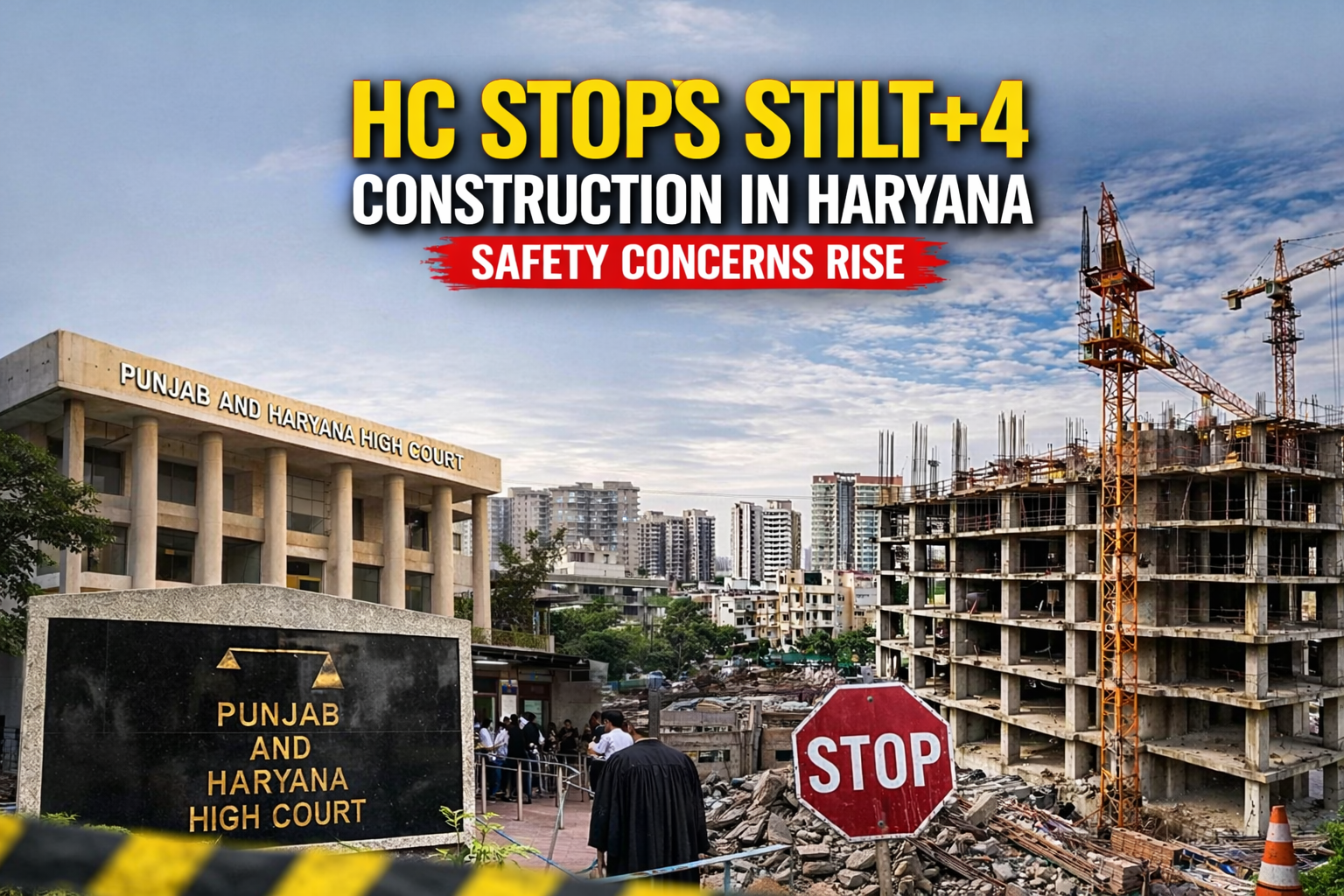
The real estate landscape in Haryana has entered a phase of uncertainty and introspection after the Punjab and Haryana High Court delivered a landmark decision—halting the controversial stilt+4 construction policy. What was once projected as a progressive move to accommodate rising housing demand has now been flagged as a potential threat to public safety and urban sustainability.
This decision is not just a temporary legal pause; it represents a deeper conflict between rapid urbanization and the capacity of infrastructure to support it. From Gurugram to Panchkula, the ripple effects of this ruling are already being felt across developers, homebuyers, policymakers, and investors.
A Policy That Promised Growth but Raised Questions
The stilt+4 policy allowed residential plots to have four floors built above a stilt parking area. The idea was simple—maximize land utilization, increase housing supply, and enable more ownership opportunities in high-demand cities.
On paper, it appeared to be a practical solution to urban density challenges. Haryana, especially cities like Gurugram and Faridabad, has witnessed exponential population growth over the past decade. With limited land availability, vertical expansion seemed inevitable.
However, what started as an opportunity soon exposed cracks in planning and execution.
According to reports, the High Court intervened after observing that the policy might have prioritized revenue generation over public safety.
Why the High Court Stepped In
The court’s decision came in response to multiple Public Interest Litigations (PILs) challenging the legality and practicality of the policy. Petitioners raised concerns about overcrowding, poor infrastructure, and potential safety hazards.
One of the most striking observations made by the court was that the government appeared to have put citizens at risk “merely to earn more revenue.”
The court highlighted several critical issues:
1. Infrastructure Mismatch
Cities like Gurugram were never designed to support such high-density vertical development. Basic civic systems—roads, drainage, sewage, and water supply—were already under stress.
2. Absence of Infrastructure Audit
The court criticized the government for not conducting a proper infrastructure capacity assessment before implementing the policy.
3. Narrow Roads and Accessibility Issues
An expert committee found that internal roads in some areas were as narrow as 3.9 to 4.8 meters, far below the required standards.
4. Emergency Response Concerns
Narrow roads and congested layouts pose serious risks for fire trucks, ambulances, and disaster response systems.
Ground Reality: Infrastructure Under Pressure
The High Court’s observations align with on-ground realities that residents have been experiencing for years.
In many residential sectors:
- Parking spillovers have choked internal roads
- Sewage systems are operating beyond capacity
- Waterlogging has become a recurring issue
- Traffic congestion has intensified
Reports also indicate widespread unauthorized construction and misuse of stilt floors, further aggravating the situation. Authorities have already been directed to act against such violations and encroachments.
This clearly indicates that the problem is not just policy-driven but also rooted in weak enforcement and regulatory lapses.
The Builder Floor Boom: A Double-Edged Sword
The stilt+4 policy fueled a massive surge in builder floor developments across Haryana. For developers, it opened doors to maximize returns on small land parcels. For buyers, it created relatively affordable ownership options compared to high-rise apartments.
But this boom came with hidden costs:
- Overcrowded neighborhoods
- Increased strain on shared resources
- Reduced privacy and open spaces
- Compromised structural safety in some cases
The unchecked proliferation of builder floors transformed the character of planned sectors, often turning them into high-density clusters without corresponding infrastructure upgrades.
Legal and Policy Implications
The High Court’s interim stay has wide-ranging legal and regulatory implications.
Immediate Impact
- Halt on new approvals for stilt+4 constructions
- Suspension of ongoing projects under scrutiny
- Increased inspections and enforcement drives
Long-Term Impact
- Likely revision of building norms and policies
- Mandatory infrastructure audits before approvals
- Stronger compliance mechanisms
The case also sets a precedent for other states facing similar challenges, emphasizing that urban expansion cannot come at the cost of safety.
Impact on Real Estate Market
The decision has triggered mixed reactions across the real estate ecosystem.
For Developers
Developers are facing uncertainty, especially those with ongoing or planned stilt+4 projects. The halt could lead to:
- Project delays
- Financial strain
- Inventory pile-up
However, it also pushes developers towards more responsible and compliant construction practices.
For Homebuyers
For buyers, this decision is both a warning and an opportunity.
Warning:
Not all builder floor projects are structurally or legally sound.
Opportunity:
Greater focus on safety, compliance, and long-term value.
For Investors
Investors may experience short-term hesitation but long-term clarity. The market is expected to shift towards:
- Regulated developments
- Gated communities
- Infrastructure-backed projects
Urban Planning Lessons from the Crisis
The stilt+4 controversy exposes deeper flaws in urban planning across rapidly growing Indian cities.
1. Planning vs Execution Gap
Policies often look good on paper but fail due to poor execution and lack of coordination between agencies.
2. Reactive Governance
Instead of proactive planning, authorities often respond only after issues escalate.
3. Infrastructure Lag
Urban infrastructure development continues to lag behind real estate growth.
4. Lack of Accountability
Unauthorized constructions and violations thrive due to weak enforcement.
Gurugram: The Epicenter of the Debate
Gurugram has emerged as the focal point of this issue. Known for its rapid urbanization and premium real estate, the city is now grappling with the consequences of unplanned growth.
The High Court noted that increasing floors without adequate infrastructure backup could push the city toward collapse.
From traffic congestion to waterlogging, the city’s challenges highlight the urgent need for sustainable development models.
Government’s Response and Crackdown
Following the court’s decision, authorities have initiated strict actions:
- Removal of encroachments on roads
- Crackdown on unauthorized stilt usage
- Demolition drives in select areas
- Demand for compliance reports from agencies
A time-bound action plan is being implemented to restore urban order and ensure safety compliance.
What Should Buyers Do Now?
This situation calls for smarter decision-making by homebuyers.
Key Checklist Before Buying:
- Verify building approvals and compliance
- Check road width and infrastructure capacity
- Ensure proper parking provisions
- Avoid unauthorized constructions
- Prefer reputed developers and planned societies
Buying a property is not just about price or location—it’s about long-term safety and livability.
The Way Forward: Towards Sustainable Urban Growth
The High Court’s decision should not be seen as a setback but as a corrective step.
What Needs to Change:
- Infrastructure-first development approach
- Strict enforcement of building norms
- Transparency in approvals
- Technology-driven urban planning
- Citizen participation in planning decisions
Urban growth is inevitable—but it must be guided by sustainability, safety, and accountability.
Expert Insight: A Turning Point for Indian Real Estate
This ruling marks a significant shift in how real estate development will be approached in India.
It sends a clear message:
Speed cannot replace safety. Density cannot override planning. Revenue cannot compromise lives.
For developers, it is a call to build responsibly.
For buyers, it is a reminder to invest wisely.
For policymakers, it is a push to rethink urban strategies.
Conclusion
The halt on stilt+4 construction in Haryana is more than just a legal development—it is a wake-up call for the entire real estate ecosystem.
As cities continue to expand, the focus must shift from rapid construction to responsible development. The future of urban India depends not on how fast we build, but on how well we build.
This moment, though disruptive, could pave the way for safer, smarter, and more sustainable cities—if the lessons are learned and implemented effectively.
- builder floors Haryana
- Gurugram infrastructure issues
- Gurugram real estate news
- Haryana High Court decision
- Haryana property market
- Haryana stilt+4 policy
- high court stay construction
- housing safety concerns
- property investment Haryana
- real estate regulation India
- residential construction rules Haryana
- stilt parking floors
- urban infrastructure crisis
- Urban Planning India







Punjab Tightens Rules: PPCB Shields Buyers from Non-Compliant Builders
Punjab PPCB eases rules for buyers, allows sale deeds & power while...
PropertyPockets4 Mins read

Punjab to Acquire 11,103 Acres in Mohali & New Chandigarh
Punjab plans to acquire 11,103 acres in Mohali & New Chandigarh for...
PropertyPockets3 Mins read

Infosys Mohali Campus to Trigger Tech & Real Estate Boom
Infosys Mohali campus to boost IT jobs, infrastructure, and real estate. Mohali...
PropertyPockets4 Mins read

PR-6 Road Delay Sparks Protests in Mohali
Mohali residents demand urgent action on delayed PR-6 road. The 200-ft road...
PropertyPockets4 Mins read




Leave a comment